Friday, February 25, 2011

Montessori Insights and Reflections of a Preschool Student’s First Year

Interest in the Movable Alphabet – Part 1 of 2

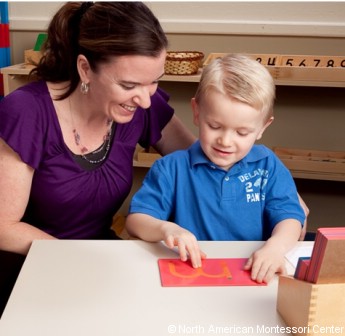
For the past couple of months, my Montessori preschool student Jordan, who just turned four years old, has been observing many of the four- and five-year-olds working with the Movable Alphabet and has obviously been inspired by his observations. Almost every day he asks to work with the Movable Alphabet, however, I know that Jordan isn’t yet ready, therefore I am continually guiding and redirecting him to other activities explaining that he still needs to learn more sounds before working with the Movable Alphabet.

I try each day to provide Jordan with a Montessori three-period lesson using the Sandpaper Letters and then record his progress on his sound card. He usually manages the first two periods with ease but often has a difficult time with the final period when I ask him to ‘recall’ the sound of the letter. It took me a long time to learn the importance of NOT correcting the child when they indicate the “wrong” letter/sound. I simply continue the lesson, thank the child for working with me and make a note on their sound card that I need to re-introduce that sound at a later date. It is very important to me that every lesson ends with the child feeling successful.

When it comes to learning, the freedom to 'make mistakes' is just as important as the independence to 'get it right' and Montessori educators need to keep in mind that both paths lead to the independence to learn and succeed. After five months of lessons with the Sandpaper Letters, something magical happened … last Friday, I sat down with Jordan along with his ‘sound card’ to confirm which ‘sounds’ he was able to identify and to my surprise, he knew 24 of the 26 sounds on his sound card … amazing! I love how moments of learning come in spontaneous bursts and suddenly the child “gets it”! Every child learns at his or her own pace and it’s a process that requires great diligence and patience. With 24 of the Sandpaper Letters under his belt, Jordan is now ready to be introduced to the Movable Alphabet!

As much as possible, NAMC’s web blog reflects the Montessori curriculum as provided in its teacher training programs. We realize and respect that Montessori schools are unique and may vary their schedules and offerings in accordance with the needs of their individual communities. We hope that our readers will find our articles useful and inspiring as a contribution to the global Montessori community.

Related NAMC blogs:

North American Montessori Center: http://www.montessoritraining.net/

Tuesday, February 22, 2011

Montessori Preschool Practical Life: Transferring Activities

Transferring is a staple activity in the Montessori preschool/kindergarten classroom. Students develop their fine motor skills, focus, and concentration while transferring small objects from one bowl or small container to another. Transferring activities can be set up in multiples so that young Montessori students may work on similar activities simultaneously. Transferring activities can match the seasons or your students’ interests (see Montessori Insights and Reflections of a Preschool Student’s First Year: Fishing-themed Activities To Spark An Interest In Practical Life). Transferring activities can be adapted and rotated as the needs of your students and your environment change.

First, gather your materials. Egg cups, miniature flower vases, small wooden bowls, ramekins, and other small containers are all available from dollar stores, thrift stores, and antique stores. Be sure to go through your kitchen cabinets and closets around your home for an interesting variety of containers and items to transfer. Let your friends and family know that you are looking for these things. Finally, remember to check your Montessori classroom and school storage for items you may have inherited from a former teacher. (Ice cube trays and egg trays can also be fun!)

As far as the items your students will be transferring into the containers listed above, the sky is the limit. Pom-poms, beads, acorns, small pinecones, beans, marbles, and any small glass, wooden, metal or fabric items are just a few of the numerous items that your Montessori preschool students can transfer from one container to another.

The transfer apparatus can be ice cube tongs, other small tongs, tweezers, or chop sticks. I usually check the kitchen and cooking sections wherever I am shopping. You can also set up spoon and finger transfer works as other options in the Practical Life area of your Montessori classroom. Finally, small trays, preferably made of natural material such as wood, bamboo, or woven material, can hold the transferring supplies.

Practical Life transferring works allow for the incorporation of items from your childhood, your travels or your students’ families and their experiences. These items allow for a level of authenticity in your Montessori environment and materials that will appeal to your Montessori students. Discussions about the items can also lead to some wonderful storytelling opportunities.

Related NAMC blogs:

North American Montessori Center: http://www.montessoritraining.net/

Thursday, February 17, 2011

Montessori Insights and Reflections of a Preschool Student’s First Year

Ideas to Reinforce Counting and Number Recognition at Home

The Montessori 3-6 Math curriculum is fascinating to learn about and provides children with such a strong foundation of quantity as well as the symbols associated with each quantity. The materials build sequentially on previous learning, they introduce concrete learning before abstract learning, they are self-correcting, and they isolate the difficulty being learned. Montessori teachers are fortunate to have such wonderful materials at their fingertips to teach such concepts, but what can parents do at home? I am continually being asked by parents for ideas that they can implement to further their child’s understanding of quantity and numerals and I have included a list of activities below. I have implemented many of the activities at home with my own children and also in the Montessori preschool. Enjoy!

Counting Ideas and Number Recognition

Ice cube tray counting: Write down numerals in an ice cube tray, or place stickers in the empty sections of a candy box. Let your child count, and place the required numbers of buttons, or beads in each section.

Count stairs: Simply count each step in your house or when you are out somewhere.

Movement counting: Combine exercise with numbers. Let your child look at the date on the calendar. If it is the 15th of the month, encourage your child to touch their toes 15 times or clap 15 times or jump up and down 15 times.

Number fishing: Attach a magnet to a string. Place cards with a numeral on each, and attach a paper clip to each card. When you call out a number, let your child fish for that card.

One-to-one correspondence: Line up 10 food baskets with numerals on them, from 0 to 10. Give your child 55 objects - spoons, pom poms, small erasers, etc., and have him/her put the required number of objects into each bucket. By the time your child is finished, there should be no objects left.

Playing cards and counting: Use playing cards and buttons. Let your child place the appropriate number of buttons on the hearts, or spades, clubs or diamonds on each card.

Outdoor number search: Look for numbers every time you’re out of the house – on license plates, shop numbers, signs/billboards, etc.

Indoor number search: Look for numbers inside the house – on cans, books, newspapers, the phone book, shoe sizes, clothes tags.

Movement games: Create a set of index cards with a single numeral on each. Hold up each card and ask her to hop or jump as many times as the number on the card.

Tactile numbers: Write numbers on a large sheet of paper, and invite your child to use play dough to create and trace number shapes on each number on the paper.

Tactile numbers: Let your child dip a cotton swab in paint, and trace numbers which you have written on a sheet of paper.

Number bingo: Create a squared piece of paper and in each square write a different number. Provide the child with the squared paper as well as a handful of counters and prepare to play Bingo. The parent or teacher should hold up one number at a time which may or may not match the numerals on the squared paper. Each time the child sees a number that matches what’s on their squared paper, they should cover it with a counter. When the child gets a line of counters, he/she says, “BINGO”

Counting with jars: Provide the child with 55 counters (i.e., erasers, shells, beads, craft sticks, etc.) along with 11 jars. Be sure to label each jar with a numeral from 0 to 10. Then, invite the child to arrange the jars in order from 0 to 10 and then place the correct amount of items in each jar.

As much as possible, NAMC’s web blog reflects the Montessori curriculum as provided in its teacher training programs. We realize and respect that Montessori schools are unique and may vary their schedules and offerings in accordance with the needs of their individual communities. We hope that our readers will find our articles useful and inspiring as a contribution to the global Montessori community.

North American Montessori Center: http://www.montessoritraining.net/

Tuesday, February 15, 2011

Montessori Insights and Reflections of a Preschool Student’s First Year

Sound Awareness: Language Activity Ideas for Parents

The Montessori language curriculum is an integrated approach that combines phonetics and whole language. Children are first introduced to the sounds of each letter using the well loved Montessori Sandpaper Letters. Once several sounds are mastered, they can begin to write and read words by linking the sounds together. Phonemic awareness (i.e., sound games) is an incredibly important aspect of learning to read and write and essentially, provides the foundation for more advanced work. A Montessori classroom is well equipped with a wealth of Language Arts materials to inspire young children and spark an interest in Language Arts. What can parents do at home? Parents are always asking for activity ideas that they can implement at home to follow up with what is being taught at Montessori preschool. I have included below a list of activities that might be helpful.

Sound Awareness, Writing and Reading Ideas

Reinforce Lowercase Letters and Phonetic Sounds: Always teach and reinforce lower case letters (not capitals) as well as the phonetic sounds of each letter (not the actual name). In reading it is the ‘sounds’ that count.

I Spy: Develop sound awareness by playing “I Spy” … I spy with my little eye something that starts with the sound ‘h’… Your child needs to search around the house and find an object that begins with that sound (hat).

Promote Writing via a Dry Erase Board: If your child has begun to write at school, let your child write on a dry erase board … they love the dry erase markers and eraser brush. They can practice forming letters over and over again!

Use a Chalkboard: Similar to a dry erase board, the child can practice forming their letters, and creating words. The best part is that they can erase their letters with an eraser brush and start all over again.

Excellent website: Great games and activities to help your child read and write: http://www.readinglesson.com/

“Fishing for Sounds”: Cut out index cards or cardstock in the shape of fish. Write the letter(s) on the fish. Then request a specific fish……let’s see if you can catch the ‘sss’ (sound) fish. Your child ‘catches’ the fish that has the letter written on it. NOTE: You can even make a magnetic ‘fishing pole’ (a stick, string and magnet) and on each fish, place a paper clip that can be “caught” using the magnetic fishing rod.

Read Nursery Rhymes: Read and reread favorite nursery rhymes to reinforce the patterns of the language and enjoy tongue twisters and other forms of language play together.

“Go Fish” Card Game: Write the sounds on the cards. Have the child ask “do you have a /__/” (say the sound). For example “Do you have a /s/?” No, go fish! Yes, hand it over!

Catching “Sound Butterflies”: Cut out the index cards or cardstock in the shape of butterflies. Write the letter(s) on the ‘butterflies’. Give your child a small net and let them ‘catch’ the specified “sound butterflies”. For example, “let’s see if you can catch me the “f” butterfly.

Focus on Rhyming: Read favorite poems, songs, and stories over and over again and discuss alliteration and rhyme within them.

Collecting “Sound Cars”: Cut out the index cards or cardstock in the shape of cars. Write the letter(s) on the cars. The child collects the sound cars when he says the correct sound!

Magnetic Sound Fishing: Collect metal lids from jars (no sharp edges, please) and label each lid with a different sound/letter. Then provide the child with a magnetic fishing rod and sing the following song to the tune of Farmer in the Dell. The child should “catch” the requested sound/letter.

A fishing we will go, a fishing we will go
Please catch a “p” from our Sound Pond
And then please let it go!

“Sound Bingo”: Make bingo cards with 3x3 or 4x4 grids with the letter(s) your child needs to practice written on the squares. Then call out the sounds (not letter names). For example, do you have /s/, do you have /m/, etc. Use the ‘sound tiles’ or make ‘bingo chips’ with the letters printed on them. The child must find and match the correct ‘sound tile’ or bingo chip to the correct bingo square. AND of course the child must always say the correct sound!

‘Sound Hopscotch’… All you need is an energetic child and some sidewalk chalk! Write different sounds in each square and have child say the sound as they hop on a square.

Magnetic Letters: Encourage children to play with magnetic letters and to explore letter/sound relations.

Focus on Syllables: Count the syllables in various words by clapping or using other body movements (jumping, stomping, dancing)………but- ter- fly. Another idea is for the child to play basic percussion/ rhythm instruments to reinforce the various syllables.

Read, read and read some more: The more you read to children the better equipped they will be to identify the sounds in words, to build words on their own and to begin the reading process.

Journal Entries: Provide children with journals (interlined notebooks) in which they can draw a picture and create a story about it. For a younger child, the teacher can write the story and the child simply traces over the letters. For an older child who knows their sounds, he/she can try and sound out the story on their own. Journals are such a wonderful keepsake!

Have fun and Happy Reading!

As much as possible, NAMC’s web blog reflects the Montessori curriculum as provided in its teacher training programs. We realize and respect that Montessori schools are unique and may vary their schedules and offerings in accordance with the needs of their individual communities. We hope that our readers will find our articles useful and inspiring as a contribution to the global Montessori community.

North American Montessori Center: http://www.montessoritraining.net/

Thursday, February 10, 2011

Montessori Insights and Reflections of a Preschool Student’s First Year

Musical Training and Activity Suggestions

In our Montessori preschool classroom, we try and incorporate a variety of music and movement activities that help to build good listening skills, promote self expression and increase a child’s self confidence. The children enjoy playing games like ‘Sound Bingo’ and ‘Name That Sound’ and they enjoy working with Montessori materials such as at the Sound Cylinders and Hand Bells. We have a specialized music teacher who comes twice a week and it is such a special time for the young students. They learn about rhythm, rhyme and melody, they have the opportunity to explore various rhythm instruments, they learn how to keep a steady beat and they enjoy exploring different types of body percussion.

At the beginning of the school year, my three-year-old Montessori student Jordan was very quiet and rarely participated in such activities. But with regular exposure in a fun and non-threatening environment, he now has the confidence to stand up in front of his peers and hum a melody as well as participate in the various games that are played during circle time and music class. The other day we were listening to a song on one of my music and movement CD’s and Jordan put up his hand and said, “Teacher Bree, I hear a glockenspiel in that song!” He was absolutely correct and I was amazed that he was able to hear and name the instrument …. such an abstract concept! I often hear Jordan humming a song or singing to himself while working with Practical Life activities and he is often curled up in our ‘Sound Corner’ exploring the rhythm instruments from around the world.

Musical training can enhance child development in so many ways. It helps children learn valuable problem-solving skills, it improves their physical coordination, their concentration, their memory, as well as their language skills. Through musical training, a child learns to be more self-disciplined, and it helps them to feel more confident with expressing themselves. Musical training improves listening skills, and instills in children a love for music! A child’s sense of worth and creative nature will surely shine through when they are given a wide range of musical opportunities.

A few ideas of activities that I have implemented over the years are as follows:

  • A Music and Movement lesson that incorporates Geography is always fun. For example, dancing to music with colored scarves that correspond to the various continents or listening to a CD with songs from around the world.
  • Challenge the children to identify everyday sounds. My Montessori preschool students love to close their eyes and put up their hand to identify different sounds that they hear in the environment and we do this both indoors and outdoors
  • Play a CD with animal sounds and encourage the students to guess which animals make each sound
  • Play a ‘copy-me game’. Make different sounds or a particular rhythm and encourage the children to copy you.
  • Challenge the children to identify the instruments being played in different songs. This activity works best with children 5 years and older.
  • Rhyming Games are always popular with young children. The children in my class love to sing Down by the Bay as well as Willaby Wallaby Woo. We sing the following song and try and incorporate each child in the class.

Willaby Wallaby Woo

Willaby Wallaby Wordan
An elephant sat on Jordan
Willaby Wallaby Welissa
An elephant sat on Melissa

  • Musical Storytelling is another fun activity that my students love. I retell an old favorite but incorporate rhythm instruments to make the various sounds.

  • Exploring instruments from around the world is a wonderful activity and a great way to promote a sense of cultural awareness!
  • A sound matching activity is certainly an effective way to help refine a child’s listening skills.
  • Freeze dancing is always a favorite and the children love freezing like statues when the music stops.
  • Listen to different genres of music and follow a series of actions.
  • Play Musical Chairs.
  • Provide the children with rhythm instruments and help them to create their very own musical band.
  • Explore ‘sound boxes’. Have a few boxes available and inside each, place a variety of items that make different sounds.
  • Make sounds shakers or rainmakers out of various recyclable materials (yogurt containers, baby food jars, toilet paper rolls, paper towel rolls, etc.).
  • Record the childrens' voices and then challenge them to identify the person whose voice they hear.
  • Take the children outdoors to encourage them to listen to animal and nature sounds.

As much as possible, NAMC’s web blog reflects the Montessori curriculum as provided in its teacher training programs. We realize and respect that Montessori schools are unique and may vary their schedules and offerings in accordance with the needs of their individual communities. We hope that our readers will find our articles useful and inspiring as a contribution to the global Montessori community.

Related NAMC blogs:

The NAMC Sensorial Development and Music Enrichment manual is a great resource for the Montessori 3-6 educator.

North American Montessori Center: http://www.montessoritraining.net/

Tuesday, February 8, 2011

Montessori Insights and Reflections of a Preschool Student’s First Year

The Path to Normalization

What exactly is a normalized classroom? A normalized classroom refers to a Montessori environment where the children are working purposefully and cooperatively. Dr. Montessori described the normalized child as “...one who is precociously intelligent, who has learned to overcome himself and to live in peace, and who prefers a disciplined task to futile idleness.” (Maria Montessori, The Secret of Childhood). The goal of any Montessori teacher is to recognize each child’s nature and allow it to grow. As the child chooses his own work and becomes absorbed in meaningful work, he soon begins working with continued concentration and inner satisfaction. When we see this in a single child, we call it inner discipline. When we see it in a whole classroom, we call it normalization. It is truly impressive to see a group of children work together in peace and harmony and it is what every Montessori teacher strives for!

To sit back and observe normalization in a Montessori environment, you would see a mixture of independent and small group work that is productive and purposeful, a high level of independence and very few discipline issues. You would observe self-directed students who are able to focus and concentrate with determination and purpose. A normalized classroom is peaceful, harmonious and beautiful and the normalized child learns to respect each material and appreciate its beauty.

There are some days where I look at my class and see nothing but a harmonious, normalized classroom, while other days I look around and wonder what has come over my students? There are days where the children seem so needy and unfocussed and I wonder what I may be doing wrong and then there are other days where everyone is working purposefully and there is a sense of calm in the classroom that is so beautiful. For the most part, my classroom is a normalized environment, but it certainly didn’t begin that way in September. I still have a handful of children who wander throughout the class, lacking focus and purposely trying to disturb their classmates. There are only a few children who behave this way and the other Montessori preschool classmates work hard to help them. When I observe a child who is not yet normalized, my goal is to guide her/him toward purposeful tasks and it is almost always the Practical Life area that I gravitate to. Today, my three-year-old student, Jordan seemed very uninterested in being at school. He was disturbing his friends and couldn’t seem to find anything that appealed to him. He was really struggling with choosing an activity to work with and finally, I said, “Jordan, it is important that you choose an activity to work with. You may choose it yourself or I can choose it for you.” Jordan chose a sorting activity and after 10 seconds or so had finished and was ready to move on. Through the morning Jordan continued to struggle with settling into the daily activities and I continued to choose activities for him in hopes to refocus him. After very little success, I asked an older classmate (Olivia) to lend a hand. I quite often will pair up an older child with a younger child and today, it worked like a charm. Olivia was able to find a few different activities that appealed to Jordan, and with encouragement and continued dialogue she managed to keep him focused and interested … what an achievement!

I am so fortunate to have many young Montessori students like Olivia; they are incredible role models for the “not-yet-normalized” children. Jordan is definitely well on his way to becoming normalized and with time, patience, and consistency, he will get there! I have to continually remind myself that laying the Montessori foundation takes time and every child adjusts to new surroundings, new friends, and new routines at their own pace. The good news is the next day Jordan came to school, he was ready and eager to work and did so with purpose and joy …phew!!!

A few tips for encouraging normalization:

  • Take care when preparing the environment to ensure it is neat, orderly, enriched and beautiful.
  • Be diligent with redirecting children who are having a difficult time remaining focused.
  • Ensure you have an enriched Practical Life area. Montessori Practical Life activities are the framework to a normalized environment!
  • Work hard to guide children toward purposeful activities that appeal to their individual needs and interests.
  • Set the tone by emphasizing Grace and Courtesy in your Montessori classroom community.
  • Be patient and confident with the notion that your Montessori environment will one day be a peaceful community.
  • Pair a “not-yet-normalized” child with one who will serve as a “normalized” role model …it’s amazing how much children can learn from one another!

The greatest sign of success for a teacher... is to be able to say, "The children are now working as if I did not exist." ~ Maria Montessori

As much as possible, NAMC’s web blog reflects the Montessori curriculum as provided in its teacher training programs. We realize and respect that Montessori schools are unique and may vary their schedules and offerings in accordance with the needs of their individual communities. We hope that our readers will find our articles useful and inspiring as a contribution to the global Montessori community.

NAMC Related Blogs:

North American Montessori Center: http://www.montessoritraining.net/

Tuesday, February 1, 2011

Collaboration Among Montessori Teachers – Part 2 of 2

Expanding Partnership Opportunities

Collaborating with Montessori colleagues outside of your classroom or school can be extremely beneficial. An example may be a collaborative partnership with a teacher (or teachers) of a similar age group as your Montessori classroom. Comparing notes and observing each other’s environments, record keeping, materials, etc, all contribute to ongoing improvements in your own skills and your Montessori prepared environment. Ideally, your collaboration partner is someone who is outside of your daily classroom routine and can provide you with fresh and invaluable insights. This person could be another teacher at your school, a teacher at a nearby school, a teacher in another state or country, or a retired teacher.

Incorporate any and all technologies for this partnered collaboration. Meet face-to-face, via web cam (i.e., Skype), tour their classroom virtually through photographs or a slideshow, or write notes, emails, and letters. (You can incorporate many of the ideas in Part 1 by using these technologies.)

Your collaborative partner can become an invaluable asset for you and how you approach your teaching. If you have a specific problem, issue, or question about a student, a Montessori material, or your Montessori environment, you can solicit advice or initiate a problem-solving discussion with your collaborative partner. Your partner’s input can also be very helpful when you are examining and evaluating the flow and content of your curriculum.

Of course it would be ideal to partner with a Montessori teacher who also teaches the same age group as you, but truly, a Montessori teacher of any age group can be a potentially good collaborative partner. If you are feeling especially adventurous, you may choose to partner with a teacher at a non-Montessori school or even a home schooling parent. Ideally, as long as the other teacher inspires you and holds you accountable to your goals and ideas (and vice-versa), you will both benefit from this shared effort.

As we move forward in this new calendar year, consider suggesting collaborative partners as a school-wide opportunity and exercise. It may be a positive way to renew your colleagues’ energy and enthusiasm during the middle of the school year.

Related NAMC blogs

North American Montessori Center: http://www.montessoritraining.net/